
Resumes and Letters of Introduction
These might be unfamiliar terms.
A Resume describes how YOU have all the skills that the job requires.
A Letter of Introduction, introduces you to your potential employer, and tells them how excited you are to work with them.
Resume
Also called a a CV (curriculum vitae) this is a formal document that lists the skills and relevant details describing you as the best candidate for a job.
Like dressing sharply for an interview, this document makes your first impression with and employer. Because of this It needs to have the following:
- Printed on high quality paper.
Heavy stock paper, of a color slightly different that normal white paper. Not loud or garish, but a light off-white or cream color is appropriate. Just enough so when yours is sitting in a pile of papers, it stands out and is easy to locate. - Make one for each job that you apply for.
People don’t understand that you don’t just print one and think it will work for all jobs. Make yourself a ‘master’ resume with all of your skills and education on it, then for each job make a copy of it where you move all the skills that the employer is looking for to the top making them easy to spot. - Make sure ALL the Job offer’s requirements are easy to spot on the resume
On every job offer, they say what skills they are looking for. Make sure when you make your new resume that you use the EXACT same wording as they do, and make sure ALL the skills they want are EASY to see on your resume. Having evaluated hundreds of resumes, I can tell you that an employer mentally checks off the skills in their head as they quickly read your resume. The sooner they can check off those skills on YOUR resume, the sooner it goes into the “call for interview” pile.
How a Resume is laid out…
The resume needs to be brief and directly to the point when the employer reads it. The ALL of skills listed on the help wanted ad need to be OBVIOUS on the resume.
The basic structure of the resume is as follows: (the blue parts are examples for an imaginary job applicant)
- Personal Summary
This is a short paragraph that describes all the skills you have that exactly match the job wanted ad, and how you got those skills. - Professional Experience
This is where you list your job history. Each item will be in this format:
2000-2002 George’s Sandwich Shop
Baker – South Towne Location
As a baker I was responsible for managing the supply levels, and baking schedules for the location. Additionally I baked specialty artisan breads, minimizing waste and maximizing prompt production during meal hours.
Skills: Inventory Management, Time Management, Customer Relations, Problem Resolution - Related Education
We use the word “related” so that we can make this list brief (of when we have no education, it looks that way). Typically you format it this way:
FORMAL
James Madison High School – 2010
Graduate
Madison College – 2015
Associate Degree – School of Business Culinary Arts
TECHNICAL
Principles of Sanitation
Food Theory
Professional Cooking 1,2
Waitstaff Training
MANAGERIAL
Waitstaff Training
CERTIFICATIONS
OR ServSafe Certification - References
These are the people you worked with that will speak well about you. They will need to be able to agree with everything you said on your resume. Each entry is formatted this way:
George Annensen – Owner
Georges Sandwiches, Madison, Wisconsin
Contact at: 608-555-1221 gannensen@eatsandwiches.com (Business)
Keep in mind that these will need to be made uniquely for each job that you apply for. DON’T just re-use an old resume. You need to make sure that you specifically speak to every one of the job requirements that were listed in their help wanted ad to make sure that you get the job!
Letter of Introduction
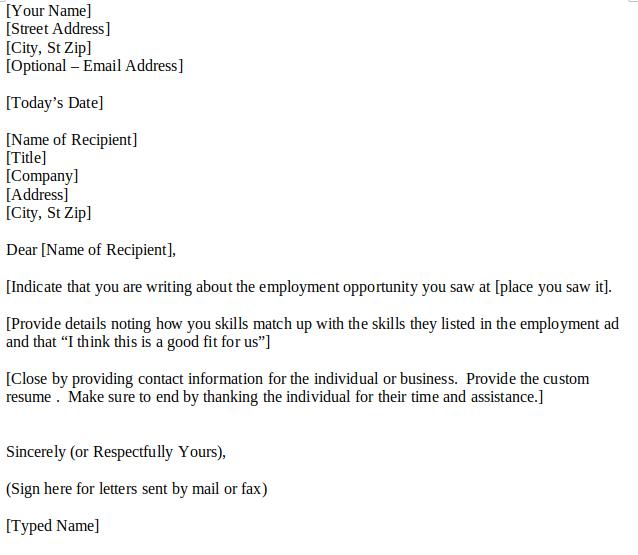
This is just a simple letter that introduces you to a potential employer. You will bundle this together with the resume. Like a resume, it needs to be custom written for each job offer in order to be effective. It needs to have these elements:
Now what do you do?
Once you have produced the Resume and the Letter of Introduction, put them in an envelope together.
Now you can either, call on the employer personally and hand them the envelope when it is appropriate, or you can address the envelope and postal mail it to the employer.